
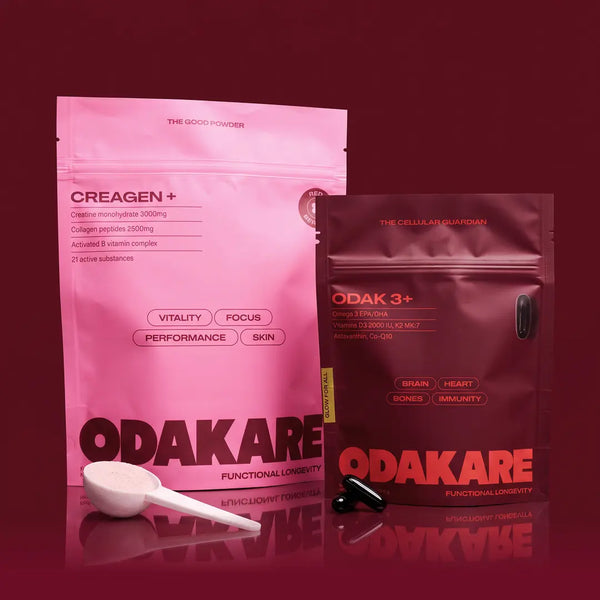


There's a lot of talk about innovation in our industry. About "revolutionary" formulas, "breakthrough" actives, molecules no one had heard of six months ago that suddenly promise to change everything. We prefer to talk about verification. Because in functional nutrition, innovation is too often a sales pitch dressed up as science: a word that sounds good and, most of the time, rests on almost nothing.
Our starting point is the opposite. Behind each of our actives is a body of research we read before selecting it: clinical trials, meta-analyses, systematic reviews, dosages that have proven themselves rather than trends that make noise. This work isn't spectacular. It doesn't make for good storytelling. But it's what separates a supplement you can stand behind from one you can only hope works.
SELECTING AN ACTIVE STARTS WITH VERIFYING IT
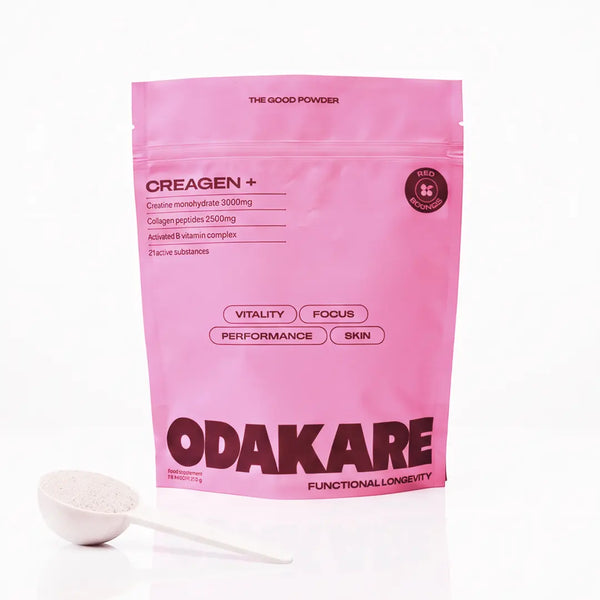
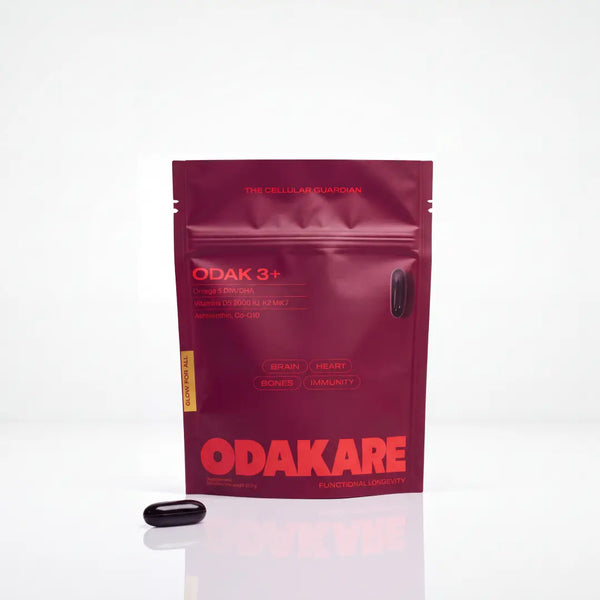
Choosing an ingredient should be a difficult decision. For many, it's a marketing decision: spot what's trending, what sells, what "feels modern", and add it to the formula. We do things differently. Before a molecule goes into CREAGEN+ or ODAK 3+, it has to answer three simple questions, and they are often deal-breakers.
Is the research solid? Not a single isolated study, funded and never replicated, but a body of converging work, ideally carried out in humans and confirmed by meta-analyses. Does the dose used in our formulas match the one that actually showed an effect? And finally: does this active bring something that diet doesn't already cover properly? If any of the answers is missing, the ingredient doesn't make the cut, however appealing it may look on a label.
It's a demanding method, and deliberately conservative. It has led us to rule out "fashionable" actives. It also leaves us with shorter, clearer and, above all, more honest formulas.
CREATINE MONOHYDRATE: THE BORING CHOICE THAT GOT IT RIGHT
Take the creatine monohydrate in CREAGEN+. There's nothing exotic about it. In many ways, it's actually a "boring" ingredient: it's been studied for decades, it doesn't make headlines, and no lab claims to have reinvented it last month. And that's exactly why we chose it.
Creatine is one of the most studied molecules in all of nutrition, with a volume of research very few actives can claim. It is recognised for supporting physical performance during intense, repeated efforts, an effect that has been documented, measured and replicated. We didn't opt for a "next-generation" version with a longer name and a higher price: we chose the monohydrate form, the one used as the reference in the vast majority of studies, at the dose that actually showed results in them. Where others try to stand out through novelty, we prefer to align with what has been verified.
OMEGA-3 AND VITAMIN D: DOCUMENTED RATHER THAN TRENDY
The same logic applies to ODAK 3+. Omega-3 EPA/DHA and vitamin D are among the best-documented nutrients there are, studied for decades and extensively described in the literature. They're not discoveries; they're foundations.
Yet these foundations are often missing from the modern diet. Our plates have moved away from natural sources of omega-3, and sun exposure (from which the body gets part of its vitamin D) is, at our latitudes and with our lifestyles, largely insufficient for much of the year. In other words: we didn't add these nutrients because they "look good" on a product sheet, but because research documents them solidly and the modern diet covers them poorly. That's exactly the kind of gap a supplement makes sense to fill.
DOSAGE: THE PRECISION EVERYONE FORGETS
Choosing the right active isn't enough: it also has to be dosed as in the studies that validated it. This is the most overlooked point in the industry. Everywhere you look, there are formulas lining up a long list of prestigious ingredients… present in such small amounts that no documented effect is plausible. The name is there; the dose isn't. The list impresses; the biology doesn't follow.
Our main actives are dosed as in the studies that validated them, and each complementary active has its reason for being in the synergy. That's less of a selling point on a label, where a formula that looks "rich" is reassuring. But between appearing complete and being effective, we've made our choice. A dosage aligned with the research isn't a detail: it's the difference between an ingredient and a decoration.
A SCIENCE THAT ACCEPTS ITS LIMITS
A human science is also a science that accepts its limits. We don't claim to solve everything, or promise eternal youth. That would betray the very approach that guides us. We aim to support a body that ages, day after day, with the most reliable things research has validated: no more, but no less either.
This humility isn't a commercial weakness; it's a form of respect. Respect for science, which advances through doubt and verification far more than through certainty. And respect for you, who deserve to know exactly what you're taking, why, and on what basis we say so.
So when people talk to us about innovation, we answer with verification. When someone sells us a promise, we look for the proof that comes before it. Everything else, the molecules that make noise, the endless lists, the results too good to be documented, isn't science: it's marketing.